
I started out by asking the class “Why do we study our scriptures?” I got lots of wonderful answers like “because it brings us closer to God”, “it reminds us of what is most important”, “we can learn from the lessons of the past” and ” they teach us what we need to do.” All these answers are correct yet I think that the real reason we study our scriptures is because the scriptures are the gateway to personal revelation. It is through them that we receive personal direction and power to guide our lives and our families.
I illustrated this point by having someone read the first eleven verses of D&C 138, in which the Prophet Joseph F. Smith gives an account of how he received his beautiful vision of the spirit world. I asked the reader to stop every time Joseph F. Smith mentioned what he DID before he received his revelation and I wrote the verbs on the board. Here is what we came up with.
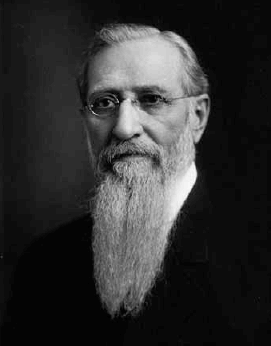
Joseph F. Smith
On the third of October, in the year nineteen hundred and eighteen, I sat in my room pondering over the scriptures; And reflecting upon the great atoning sacrifice that was made by the Son of God, for the redemption of the world… While I was thus engaged, my mind reverted to the writings of the apostle Peter… I opened the Bible and read the third and fourth chapters of the first epistle of Peter, and as I read I was greatly impressed, more than I had ever been before… As I pondered over these things which are written, the eyes of my understanding were opened, and the Spirit of the Lord rested upon me, and I saw the hosts of the dead, both small and great.
We then talked about each of these verbs and how, just like Joseph F. Smith, we too can receive powerful revelations and visions as we study our scriptures.
1) The first thing is that he SAT
This may seem like something so simple that it is easy to over look the importance of it. In Preach My Gospel, the manual given to LDS missionaries, one of the first pieces of advice that it gives missionaries about scripture study is to
“Be alert. Exercise, shower, and pray before you study. Study at a desk or a table where you can write (not lying down or sitting on your bed), organize your study materials, and remain alert.”
I know that for me the times when I have best the scripture study is when I am treating it like a real study. When make the time to sit at the table, to get my scripture study journal out, to have my markers and sticky notes nearby, and my pen ready to write. I feel like by showing the Lord that I am alert, attentive and there to take notes on what he teaches me that he responds by taking me seriously and pouring out his knowledge. If you don’t already have a designated place you sit at to study your scriptures then I recommend you find one. It is really amazing the difference it makes to study your scriptures at the table, instead on the couch, and to have a pen and journal ready instead of just reading a few verses before you hop into bed.
Think about it this way. How would a professor react if you showed up to his class with no backpack, no notebook, no pencil to take notes with, and were slouching in your seat struggling to stay awake. He wouldn’t think that you were very serious about learning and probably wouldn’t give you the type of attention he would the student who was sitting on the edge of their desk, pen in hand furiously scribbling down notes. Spiritual learning isn’t all that different from secular learning and if we want to get good grades (ie. personal revelation) then we need to show the Lord we are prepared and ready to learn.
2) He pondered
Pondering is more than just thinking about what you are reading. Pondering requires you to slow down and to reflect. It is proably the most important part of studying your scriptures. Taking the time to ponder is what changes it from “reading your scriptures” to “studying your scriptures”. There are three main ways that I like to ponder.
- Re-read the text. If you get to the end of a chapter or a verse (especially if you are reading Isaiah or Revelations) and your reaction is “What in the world did I just read?” then I’d recommend you stop, turn around and go back and read it again… and again… and again… until you are able to understand just a little bit more than you did before. I think too often we are so set on getting to the end of the chapter or reaching a preset number of verses that we skip over the parts we don’t understand instead of taking the time to work through them and figure out what they mean. It is really okay to slow down. When it comes to scripture study remember your goal is to gain personal revelation… not to fly through to the end of the the book. It is about quality, not quantity.
- Visualize yourself in the story. I find that this pondering technique works really well for the stories in the Old Testament or in the Book of Mormon. It is amazing how a story can change when you slow down and start wondering about the people in it. How did those events make them feel? Why did they make the choices they made? How would I have reacted in a similar situation? I also always like to think about where the women– even if they aren’t mentioned– would have been in the story. It helps me rememberer that these people were REAL and that they weren’t all that different from me.
- Ask questions and write them down. If the scriptures are the gateway to revelation than asking questions is the key to the gate. The Lord has told us “Ask, and it shall be given you; seek, and ye shallfind; knock, and it shall be opened unto you.” (Luke 11:9) If we want personal revelation we have to ask for it and we have to ask the right questions. As you read your scriptures take the time to write down the questions you have, whether they are historical questions, doctrinal questions, or personal questions. Then, in later scripture studies, take the time to go back and seek out the answers. Personally, I spend 85% of my scripture study time seeking out and studying the answers to my questions.
3) He Reflected and his Mind Reverted
Reflecting is a bit different than pondering. Relefcting is the time when you start to make connections between what you are reading now and what you have read or studied in the past. For example Prophet Smith said that as he was reflecting his mind reverted
“…to the writings of the apostle Peter, to the aprimitive saints scattered abroad throughout bPontus, Galatia, Cappadocia, and other parts of Asia, where the gospel had been cpreached after the crucifixion of the Lord. I opened and read the third and fourth chapters of the first epistle of aPeter…”
He had studied his scriptures enough that his mind automatically was able to make a powerful connection. Furthermore, he acted upon his thoughts and was able to opened his bible to the exact verse he was thinking of. Not all of us are blessed with Prophet Smith’s mastery of the scriptures and so this is where marking your scriptures and writing in your scripture journal become essential. When we’ve taken the time to write down our previous thoughts about the scriptures then it is much easier for us to remember those connections and find them again in the future. If you didn’t take the time to mark your scriptures or to write things down then you will probably forget what you learned. Make sure you take the time to write things down! Also I’ve found that I very rarely remember where an exact verse is but I’ll remember a few key words from it. I then use the Topical Guide to find the verse or use the search option on the online scriptures to find the verse.
5) He was Greatly Impressed and he pondered again.
I love the word he uses “impressed” because I think it sums up exactly the feeling that one gets when they begin to see the connections, themes, and archetypes in the scriptures. Those are the moments that take your breath away and fill your soul with joy and your mind with wonder. For me those moments don’t come every time I sit down to study my scriptures but I’ve found that if I study and read my scriptures enough that eventually I will have a really good scripture study that will keep me on a spiritual high for several days. In my opinion the “greatly impressed” moments are as good as any adrenaline rush and they are what keep me addicted to reading my scriptures…or compel me to read them even on the days when I really don’t want to!
Also we don’t know how long President Smith pondered over his questions. In his account he makes it sounds like his vision instantly followed his pondering. Yet for all we know he may have pondered the same question over and over again for years… and finally this time he got understanding. I know that in my own life I often have to study the same topic or the same question over and over again (I can think of some that I’ve studied at least 10 or 12 times) before I begin to understand. I’ve learned that receiving revelation takes work and that the bigger the question or the deeper the doctrine I am delving into the more work the Lord requires from me. Yet he always answers my questions, eventually, and in ways that are greater than I ever could have imagined.
6) The Eyes of His Understanding Were Opened
Having the eyes of your understanding opened is the ultimate goal of scripture study. When you approach your scripture study with that goal in mind then all of a sudden the scriptures cease to become a “book” and become a medium through which God speaks to you and teaches you great eternal truths. No knowledge or understanding is beyond our grasp if we are willing to put forth the effort to seek it out and have the patience and faith to trust in the Lord’s timing. He will teach us line upon line and precept upon precept until we are able to comprehend all things.
If you haven’t been putting the time into your own personal scripture study as you should or as you would like to I challenge you to start doing it. Nothing is more important than receiving personal revelation… and the scriptures are the gateway to that revelation… therefore nothing is more important than studying– not just reading— your scriptures.
Is that too bold of me to say? Oh well, it is true!
Comments